

A brief history of women’s fight to wear pants - Yahoo Finance |
- A brief history of women’s fight to wear pants - Yahoo Finance
- The Borrowed-From-the-Boys Pants You’ll Wear Everywhere - Us Weekly
- It began with a traffic violation and ended with a woman pulling a gator from her yoga pants - Washington Post
| A brief history of women’s fight to wear pants - Yahoo Finance Posted: 08 May 2019 06:00 AM PDT  View photos Of all the long controversial topics that are still unsettled in 2019—abortion, immigration, etc.—you wouldn't expect that the way women and girls choose to cover their legs would be one of them. Yet here we are: In March, a federal judge struck down a rule at a North Carolina charter school that prohibited girls at the school from wearing pants. It required them instead to wear skirts, skorts, or jumpers. The school had argued that the dress code promoted "traditional values." The same month, Hannah Kozak, a senior at a Pennsylvania high school, received the guidelines for her school's upcoming graduation ceremony. "No pants," it said for girls, specifying that they were to wear a "light colored dress or skirt." Kozak had to fight the school board (paywall) for the right to wear pants. The reasons that Western societies (that is, the men in them) have devised for barring women from covering each leg individually have often fallen back on these sorts of appeals to tradition and values. Gayle Fischer, an associate professor of history at Salem State University and author of Pantaloons and Power: A Nineteenth-Century Dress Reform in the United States, explained on NPR in 2017 that authorities have frequently pointed to the values dictated by the Bible as their justification for reinforcing skirt-wearing. Deuteronomy 22:5 states that women should not wear men's clothes and men should not wear women's. You'll notice it doesn't actually say anything about pants though. Over time, it's just become culturally accepted that pants are something men wear. "It becomes part of the culture in the West that pants are a male garment, and by the time we get to the 18th and 19th century, men have been wearing pants for centuries," Fischer said on NPR. "And so everyone knows that men have always worn pants—even though of course that's not true." Pants first appeared—and persisted—because they're practical: They protect the legs and keep the wearer covered up, while still allowing for easy movement. But to women in places such as Europe and the US, they also came to represent power, equality, and freedom from the restrictions—physical, social, and moral—foisted on them. In the garment's early history, though, women were there wearing pants right alongside men. It was only later that they had to start fighting for the right. The practical origins of pantsThe three girls at the center of the North Carolina case said wearing a skirt (pdf) meant they always had to pay attention to how they positioned their legs, and it literally left them cold in the winter. It's a problem that Adrienne Mayor, a classics scholar at Stanford University, was familiar with. "I grew up in South Dakota where it's really cold, and we were not allowed to wear pants to school," she says. Mayor has made extensive study of the Greeks and their attitude toward the Scythians, a term, she explains, the Greeks used to describe what were really numerous nomadic, horse-riding tribes that spread across Eurasia—and the likely inventors of pants. The garment didn't just spontaneously appear; it's tailored, requiring multiple pieces of fabric to be assembled, unlike the simpler rectangles of fabric that the Greeks cinched and pinned as their clothing. The Scythians appear to have devised them out of necessity for a life spent on horseback. (Imagine riding a horse without pants on and you'll see why.) The oldest fragments of pants found date back to these steppe tribes, who were wearing them as early as about 3,000 years ago. According to Mayor, evidence indicates that both women and men may have donned them. Greek writings refer to Scythian women wearing pants, as do numerous paintings on vases, while archaeological sites have uncovered the remains of battle scarred Scythian women who appear to have rode and fought like the men, suggesting these women may have been the real Amazons behind the myths. "The men and women dressed the same, they had the same skills," Mayor says. The Greeks, she adds, thought pants were bizarre. They derided them as "multi-colored bags" or "sacks" for the legs, and mocked them as "effeminate," probably because women wore them along with men. (Greek folklore even variously credited three women with inventing these notoriously manly garments.) The Greeks never adopted trousers themselves. The Persians did, and, by the 5th and 6th centuries, despite their initial resistance, the Romans had as well. But for women in the West, they remained mostly off limits for quite a while longer. The fight for pantsThere are examples of women in Europe and the US wearing pants long before it was socially acceptable, as writer Kathleen Cooper detailed in The Toast, even though in countries such as the US, England, and France they could actually be jailed for it in the 18th and 19th centuries. Some would dress as men to do things such as join the military. The most famous example was probably 18th-century Englishwoman Hannah Snell, who served for years in the British navy and later become a minor celebrity after revealing that she was a woman. During the US Civil War, Mary Walker, an assistant surgeon with the Union Army, chose pants over skirts (and was once arrested for impersonating a man). In polite society, though, the fight to make it permissible for women in the US and Europe to wear pants began in earnest in the 1850s, with the women's rights movement. Feminists were seeking liberation, not just from patriarchal oppression, but from the restrictions of corsets. Though Edwardian and Victorian women had adopted them voluntarily, the undergarments literally made it difficult to move, sometimes even to breathe. Suffragists such as Elizabeth Cady Stanton saw dress reform as part of their battle for rights, and some adopted an alternative outfit in the form of baggy "Turkish" pantaloons worn with a knee-length skirt. In April 1851, Amelia Bloomer, the editor of the first women's newspaper, The Lily, told her readers about it, and thereafter the pants picked up the nickname bloomers. Bloomers were not exactly a battle cry for equality in the form of trousers, though. Pantaloons and Power author Fischer explained on NPR:
Bloomers did not suddenly break down the wall between women and pants. In fact, bloomers were only popular for a few years, in part because women didn't find them attractive. Activist Susan B. Anthony even lamented in a letter that when she went on stage to speak wearing them, people only paid attention to her clothes and didn't hear what she had to say. A woman in pants would remain a curiosity for some time. When mountaineer Annie Smith Peck summited the Matterhorn in 1895, her climbing outfit included pants. Most women of Peck's day scaled mountains in layers of heavy woolen skirts. Many didn't approve of Peck's pants, including rival mountaineer Fanny Bullock Workman, which put Peck at the center of considerable controversy.  View photos Annie Smith Peck Annie Smith Peck, mountaineer, pants-wearer. Around the turn of the 20th century, though, something else was happening that would change how Americans and Europeans dressed. Formality's grip on fashion was weakening, and sportswear was beginning to find a place in the everyday wardrobe. Ease of movement was starting to become a priority. In the 1910s, a young designer named Coco Chanel helped to spur this shift with her popular, sporty clothes; through the latter half of the 1920s, she also helped bring menswear staples into women's wardrobes, including tailored jackets and trousers. While she wasn't the only designer showing pants for women, her influence was strong. "One of the most radical developments for women was the gradual acceptance of trousers, which were no longer considered either eccentric or strictly utilitarian," write historians Valerie Mendes and Amy de la Haye in their book, 20th Century Fashion. "Chanel did much to accelerate this move and was often photographed during the day wearing loose, sailor-style trousers, known as 'yachting pants.' The most fashionable young women started to wear trousers for leisure pursuits, particularly on the beach, or for early evening wear at home, the latter in the form of luxurious, Chinese-style, printed silk pyjama suits." Pants steadily migrated beyond the realm of leisure in women's wardrobes, though there were still strict limits on where women could wear them. In 1933, actress Marlene Dietrich, who tantalized audiences as a tuxedo-clad cabaret singer in the 1930 film Morocco, caused a minor uproar by turning up to famed Hollywood hangout the Brown Derby in pants. According to the Los Angeles Times, Robert Cobb, the restaurant's owner, refused to seat her. On witnessing her rejection, a pair of comics, Bert Wheeler and Robert Woolsey, left the restaurant and came back in skirts (it's unclear whether they were allowed in). It would be decades before Cobb lifted his ban on women in pants, the Times said. View photos Actress Marlene Dietrich wears a trendsetting masculine style pant suit created by French couturiere Coco Chanel in 1933 at an unknown location. (AP Photo) Marlene Dietrich wearing a Chanel suit in 1933. The triumph of pantsHowever devoted the anti-pants faction, it couldn't stop change. During World War II, for instance, practicality trumped propriety and many women pulled on pants as they entered the workplace to fill the jobs left vacant by men going off to fight. Even after the war, as women returned to the home, the notion of a woman wearing pants was losing its shock value—in the home at least, if not yet so much outside it. In 1960, a judge ejected a woman named Lois Rabinowitz from a New York traffic court for wearing pants, telling her to come back "properly dressed" on a later date. But the image of the housewife in a full skirt was quickly growing outdated. Mary Tyler Moore made it a point to use her wardrobe choices to update that image. In the 1960s, the actress wanted the character she played on The Dick Van Dyke Show to reflect the real lives of American women. "I think we broke new ground, and that was helped by my insistence on wearing pants, you know, jeans and capri pants at the time because I said I've seen all the other actresses and they're always running the vacuum in these little flowered frocks with high heels on, and I don't do that," Moore told NPR in 1995. "And I don't know any of my friends who do that." Sponsors didn't love the "cupping under" the pants did on Moore's rear. But she sneakily incorporated pants into the wardrobe more and more, and eventually they became part of her character's look. By the time the counter-culture movement of the 1960s had reached its height, a woman in pants wasn't much to be outraged by, even if in workplaces pants remained the preserve of men for a while longer. Until 1993, it was the unofficial rule on the floor of the US Senate that women weren't supposed to wear pants. Now, of course, former senator Hillary Clinton looks practically conservative in her wardrobe of pantsuits (or you could just call them suits). Still, there are lingering reminders that women have had to travel a long road to get to a point where they can cover their legs as they choose. As recently as 2013, France revoked a law that barred women in Paris from wearing pants. Najat Vallaud-Belkacem, France's minister of women's rights, had said when the law was overturned that it "aimed first of all at limiting the access of women to certain offices or occupations by preventing them from dressing in the manner of men." (The law apparently focused on Paris because, during the French Revolution, that's where a trouser-wearing faction of the working class calling itself les sans-culottes rose against the upper classes, the men of which dressed in puffy, knee-length breeches, i.e. culottes. Female revolutionaries wanted to don trousers too, but were prohibited, and risked arrest if they did.) And then, of course, there are still cases such as the schools in North Carolina and Pennsylvania, promoting beliefs that are long outdated by this point. Kozak, the Pennsylvania senior who fought to change the dress policy for her graduation ceremony, put it succinctly. "If you'd like to argue that forcing women to wear a dress or skirt promotes 'traditional values' or helps young ladies 'meet a certain expectation,' I would like to remind you that it's 2019," she told school administrators. "Women do not have an expectation to live up to; women do not have a certain standard to meet. We are not living in the 1800s anymore." This story is part of How We'll Win in 2019, a year-long exploration of workplace gender equality. Read more stories here.
Sign up for the Quartz Daily Brief, our free daily newsletter with the world's most important and interesting news. More stories from Quartz:  |
| The Borrowed-From-the-Boys Pants You’ll Wear Everywhere - Us Weekly Posted: 09 May 2019 11:49 AM PDT Men's clothing is all about comfort and functionality. Soft, relaxed fabrics, roomy pockets and everyday pieces that happen to work for almost any occasion. Take chino pants, for example. They're just as suitable for casual wear as they are for pairing with a blazer and button-up for a job interview. Our envy is real, but that doesn't mean we'll be exclusively shopping in the men's section from now on. We don't want to give up the fit or fashionable elements of our current clothing! The Caslon Boyfriend Chinos are the perfect choice for anyone looking to experience the best parts of men's pants in a made-for-women fit. They have a slim-leg boyfriend cut, updating classic chinos to form a pant that's actually incredibly cute, but just as wearable!  See it: Get the Caslon Boyfriend Chinos for just $59 exclusively at Nordstrom! These boyfriend pants have 200 reviews right now, and shoppers are falling in love with them over and over again. One called them "a great staple in [their] everyday wardrobe," while another called them "very flattering," loving their slim silhouette. One shopper raved over them being "comfortable and easy to wear," adding in that they also "wash like a dream!" These chinos are made of a stretch-cotton twill, with 98% super-soft cotton and 2% elastane for movement. They have a four pocket style. The front pockets are slant style, and unlike pockets in most women's pants, they're actually spacious; they're not just for show! There are also two welt pockets in the back, which are such a simple way to add an element of class to a pair of otherwise casual pants. These pants are mid-rise and have a zip fly with button closure. We can wear them totally un-cuffed, but it's also a popular look to roll them up a few times, creating a cropped hem. This would look adorable with sneakers, sandals, loafers or ballet flats. It all depends on our preference, or even the season! 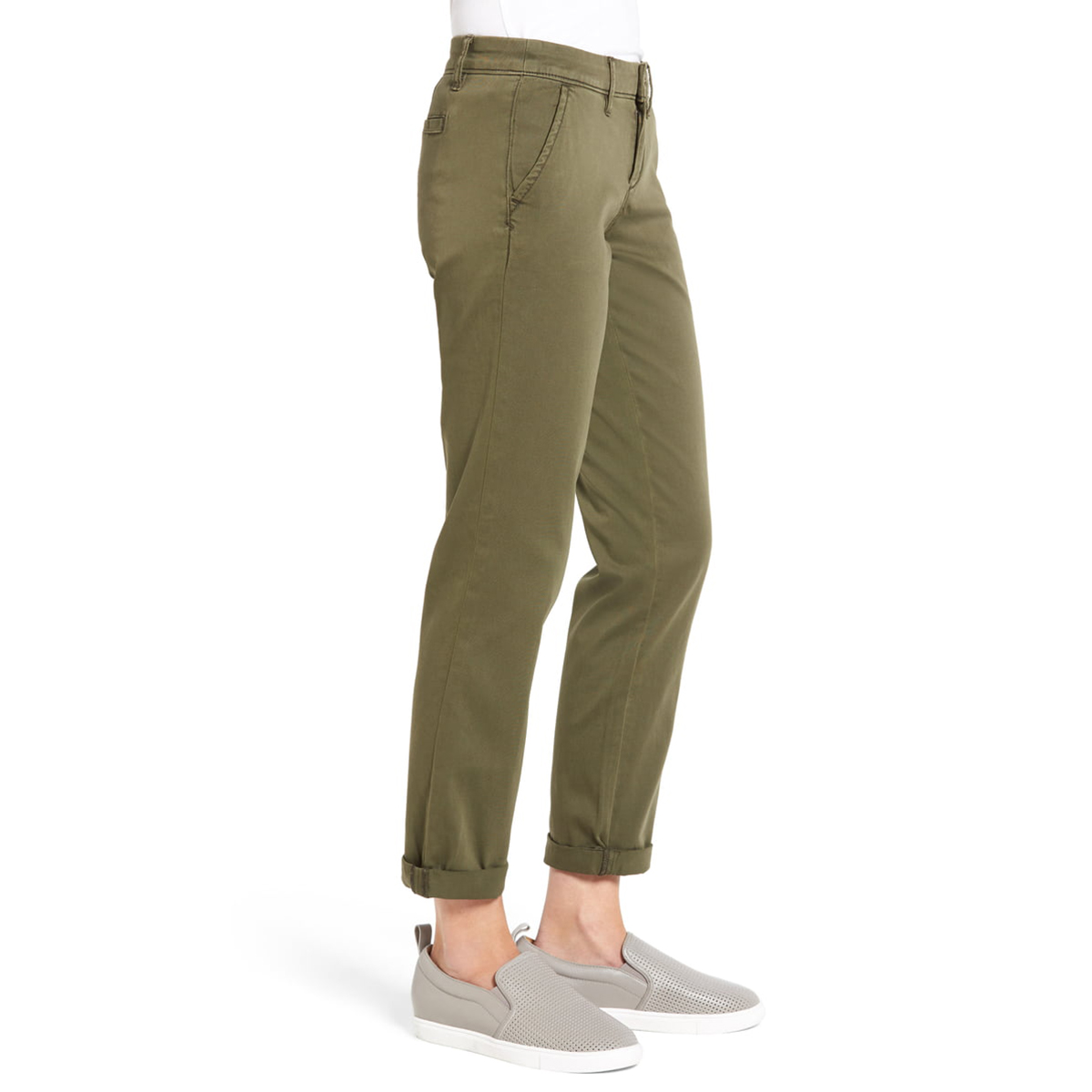 See it: Get the Caslon Boyfriend Chinos for just $59 exclusively at Nordstrom! These chinos are currently available in four colors. There are some petite sizes available, but they're going fast! Luckily, because the cropped look is so cute, regular sizing will still look great on everybody! Every color of these pants is super easy to wear and pair, true to men's style. There's Grey Ebony, a faded dark grey that complements light colors just as much as dark. We also have Navy Peacoat. A pair of navy pants is actually essential to any wardrobe. We love our blue jeans, but navy chinos take things to a new level. Also available are Olive Sarma, an earthy green, and Tan Cobblestone, which is almost ivory in color. We're not sure we can pick a favorite, but at such a great price point, maybe we don't have to! Make sure to check out the Caslon size guide right below the size drop-down list before ordering — these pants may run a little smaller than we'd expect, and Caslon wants to make sure we grab the right sizes of its "ultra-wearable" apparel. The brand is all about "eased-up and effortless" pieces. Need another example? How about these comfy linen shorts? We may be borrowing from the boys with these chinos, but we won't be giving this style back any time soon. We're keeping it and we're not looking back! See it: Get the Caslon Boyfriend Chinos for just $59 exclusively at Nordstrom! Not your style? Check out more from Caslon here and other pants and leggings available at Nordstrom here! Check out more of our picks and deals here! Sign up now for the Us Weekly newsletter to get breaking celebrity news, hot pics and more delivered straight to your inbox! Want stories like these delivered straight to your phone? Download the Us Weekly iPhone app now!  |
| Posted: 07 May 2019 03:02 PM PDT  A woman in Florida pulled this alligator out of her pants Tuesday morning during a traffic stop. She also had 43 three-stripe turtles in the car. (Charlotte County Sheriff's Office) The blue Chevy pickup truck drove west on Oil Well Road, police say, blew through a stop sign and hung a left onto Tamiami Trail in the dark of night, around 3:15 a.m., Monday. Florida sheriff's deputies turned on their lights and sirens. When they approached the pickup, the driver said he and his passenger had been collecting frogs and snakes from under a nearby overpass. The driver, Michael Cody Clemons, told officers that he and his passenger, Ariel Michelle Marchan-Le Quire, were gathering the wildlife together, according to an incident report. There are some animals that people are simply not allowed to possess in Florida, or at the very least, that people can't have unless they have a permit. Bears, tigers, rhinoceroses and crocodiles are illegal. Cougars, howler monkeys, wolves and cassowaries are fine as long as a permit is obtained. Particularly applicable in this instance: Florida law does not allow the capture or possession of poisonous reptiles — copperheads, eastern diamondbacks, coral snakes to name a few — unless there's a permit involved. [9 dead gray whales have washed up in the Bay Area. A scientist says that's 'very unusual.'] So the Charlotte County deputy asked Clemons and Marchan-Le Quire if they would open their backpacks and show their haul — just to make sure they didn't have anything illegal, the report says. Clemons, 22, had clothes and other personal items in his bag. Marchan-Le Quire, 25, grabbed her backpack from the floor next to her feet and unzipped it to show 43 small turtles piled inside, the report says. "Anything else?" a second deputy asked. It was then that Marchan-Le Quire reached into her yoga pants and tugged out a foot-long alligator. [Why two orphaned gorillas stood tall like humans in a park ranger's selfie] According to the incident report, the state's Fish and Wildlife Conservation Commission seized the animals and released them back into the wild. Clemons and Marchan-Le Quire were cited for violations of state wildlife laws. The sheriff's office joked about the incident on Twitter: "Not to be outdone by Katie Mettler contributed to this report. Read more: Coachella woman arrested after dumping seven puppies in the trash, authorities say Giraffe populations are dwindling. They're being considered for 'endangered' status. A man chucked his iguana at restaurant staff, police say. The lizard is in intensive care.  |
| You are subscribed to email updates from "pants" - Google News. To stop receiving these emails, you may unsubscribe now. | Email delivery powered by Google |
| Google, 1600 Amphitheatre Parkway, Mountain View, CA 94043, United States | |





0 Yorumlar